OpenClaw vs Nanobot: Which AI Agent Framework Should You Use in 2026?
Two open-source AI agent frameworks are vying for a spot on your computer, each offering unique strengths in the rapidly evolving world of virtual assistants. OpenClaw, developed by Peter Steinberger, has garnered hundreds of thousands of reviews in just a week, while Nanobot, created by researchers at the University of Hong Kong, stands out as a lightweight alternative with only about 4,000 lines of code. Both tools support popular messaging platforms like WhatsApp and Telegram, but they are built on entirely different philosophies. This article breaks down their differences and helps you decide which one suits your needs best.
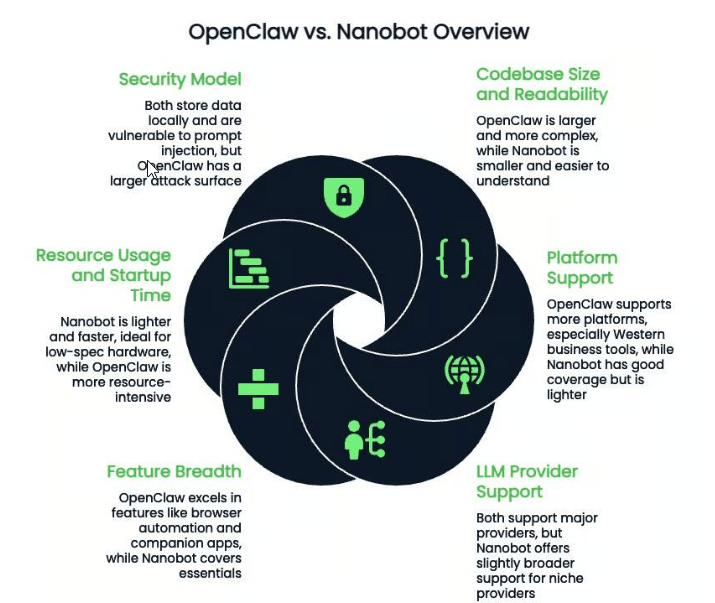
Direct Comparison of OpenClaw and Nanobot
Let’s dive into a head-to-head comparison to determine which framework aligns with your specific use case.
Size and Code Readability
OpenClaw boasts over 430,000 lines of code, primarily in JavaScript and TypeScript, making it a robust but complex system. In contrast, Nanobot is much more streamlined with around 4,000 lines of code, mostly in Python. This difference means Nanobot is far easier to understand and modify, which is ideal for developers who need quick customizations without wading through extensive codebases.
Platform Integrations
OpenClaw connects with over 12 platforms, including WhatsApp, Telegram, Signal, Discord, Google Chat, iMessage via BlueBubbles, Microsoft Teams, Slack, Matrix, Zalo, and WebChat. It’s designed for users who juggle multiple apps and want a single AI assistant to handle everything seamlessly.
On the other hand, Nanobot supports more than 8 platforms, such as Telegram, Discord, WhatsApp, Feishu, Mochat, DingTalk, Slack, Email, and QQ. While its coverage is solid, especially for business tools, it’s lighter and more focused, making it a great choice for those prioritizing efficiency over extensive integration.
LLM Provider Support
Both frameworks are model-agnostic and work with major providers. OpenClaw integrates with Claude, GPT, Gemini, DeepSeek, and local models via Ollama. Nanobot goes a step further, supporting those plus Groq, Zhipu, DashScope, Moonshot, VolcEngine, AiHubMix, and vLLM. This broader range makes Nanobot particularly appealing for users in the Asia-Pacific region who need specialized providers.
Feature Breadth
OpenClaw takes the lead in features, offering advanced capabilities like:
- Browser automation with Chromium via CDP
- Live Canvas workspaces
- Voice-activated keyword detection
- Companion apps for macOS, iOS, and Android with multi-agent routing and dedicated workspaces
- Over 100 community skills via ClawHub
- Proactive scheduling that wakes agents without reminders
Nanobot, while more essential-focused, still delivers key functionalities such as:
- Shell execution
- File import and export
- Web searching
- Cron scheduling
- Voice-to-text conversion on Telegram
- MCP support
- Modular skill systems
However, Nanobot lacks OpenClaw’s browser control, visual workspaces, and depth of companion apps, making it better suited for straightforward tasks.
Resource Usage and Startup Time
Nanobot is significantly lighter, with faster startup times and lower RAM usage, which is perfect for low-spec hardware like Raspberry Pi, basic home servers, or low-config VPS. OpenClaw runs as a long-running daemon with multiple processes and WebSocket ports, demanding more memory for smooth operation. If you’re working with limited resources, Nanobot is the more practical option.
Security Model
Both tools store data locally and require API keys, but they’re vulnerable to code injection attacks if compromised. OpenClaw has a larger attack surface due to its extensive integrations and third-party skills ecosystem. For instance, Cisco reported a real-world case where a community skill led to data theft without user knowledge, and CrowdStrike has published detailed guides for enterprise security teams managing OpenClaw deployments.
Nanobot’s smaller size and simpler architecture mean less to audit, though simplicity doesn’t guarantee safety. Both require careful permission management to mitigate risks.
Which One Should You Choose?
In 2026, the choice between OpenClaw and Nanobot depends on your priorities. If you need a feature-rich, all-in-one solution for complex, multi-platform workflows, OpenClaw is the way to go—despite its higher resource demands and security considerations. For lightweight, efficient AI assistance on modest hardware, especially in business or regional contexts, Nanobot offers a more accessible alternative. Ultimately, evaluate your setup and requirements to make the best decision.