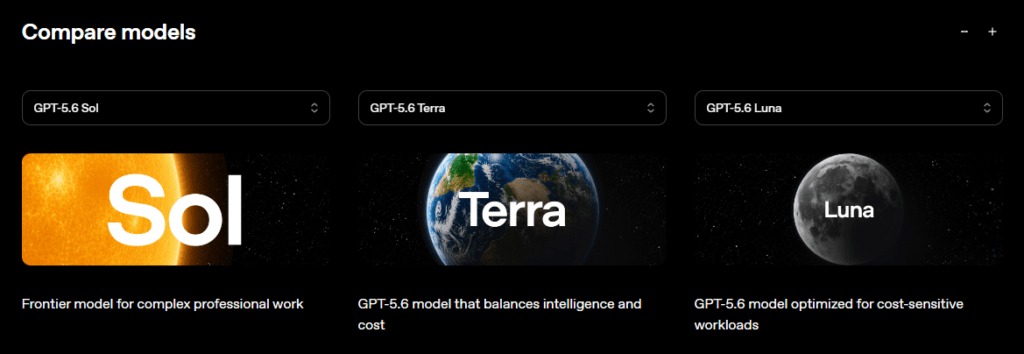
OpenAI has officially unveiled GPT-5.6, the latest generation of its AI models for the API platform. Instead of releasing a single flagship model, OpenAI now offers three different variants:
- GPT-5.6 Sol – The most powerful model
- GPT-5.6 Terra – The balanced option between performance and cost
- GPT-5.6 Luna – The fastest and most affordable model
This marks a significant shift in OpenAI’s strategy, allowing developers and businesses to choose a model that best matches their workload, budget, and performance requirements.
What’s New in GPT-5.6?
According to OpenAI, GPT-5.6 focuses on three major improvements:
- Better reasoning capabilities
- More accurate coding performance
- Lower deployment costs through optimized pricing tiers
The flagship GPT-5.6 Sol reportedly delivers around 54% better performance on Agent Coding tasks compared to the previous generation while maintaining a similar pricing structure.
GPT-5.6 Model Lineup
1. GPT-5.6 Sol
GPT-5.6 Sol is the flagship model and offers the highest level of intelligence available.
It is ideal for:
- Advanced AI agents
- Large-scale data analysis
- Complex programming tasks
- Scientific research
- Long-form conversations
- High-quality content generation
If your priority is maximum reasoning ability and coding performance, Sol is the best choice.
Advantages
- Highest accuracy
- Excellent reasoning
- Outstanding coding capabilities
- Large context window
Drawback
- Highest API cost among the three models.
2. GPT-5.6 Terra
GPT-5.6 Terra is designed to provide the best balance between performance and affordability.
OpenAI positions Terra as the recommended model for most business applications.
It is well suited for:
- Customer support chatbots
- AI assistants
- SEO article writing
- Email generation
- Workflow automation
- CRM systems
- ERP platforms
- Internal enterprise AI solutions
While slightly less capable than Sol, Terra offers excellent performance at roughly half the cost, making it the most practical option for everyday AI development.
3. GPT-5.6 Luna
GPT-5.6 Luna is the most cost-effective model in the GPT-5.6 family.
It is designed for applications that require massive request volumes while keeping costs low.
Typical use cases include:
- High-traffic chatbots
- Fast-response AI assistants
- Data classification
- OCR processing
- Document summarization
- Large-scale AI services handling millions of requests per day
If your priority is speed and affordability, Luna is the ideal choice.
Which GPT-5.6 Model Should You Use?
| Use Case | Recommended Model |
|---|---|
| Professional software development | GPT-5.6 Sol |
| AI Agents | GPT-5.6 Sol |
| Long document analysis | GPT-5.6 Sol |
| SEO content creation | GPT-5.6 Terra |
| Enterprise chatbot | GPT-5.6 Terra |
| Automation (n8n, Make, Zapier, etc.) | GPT-5.6 Terra |
| Large-scale customer chatbot | GPT-5.6 Luna |
| Data classification | GPT-5.6 Luna |
| Information extraction | GPT-5.6 Luna |
| FAQ chatbot | GPT-5.6 Luna |
GPT-5.6 API Pricing
OpenAI continues to charge based on one million tokens.
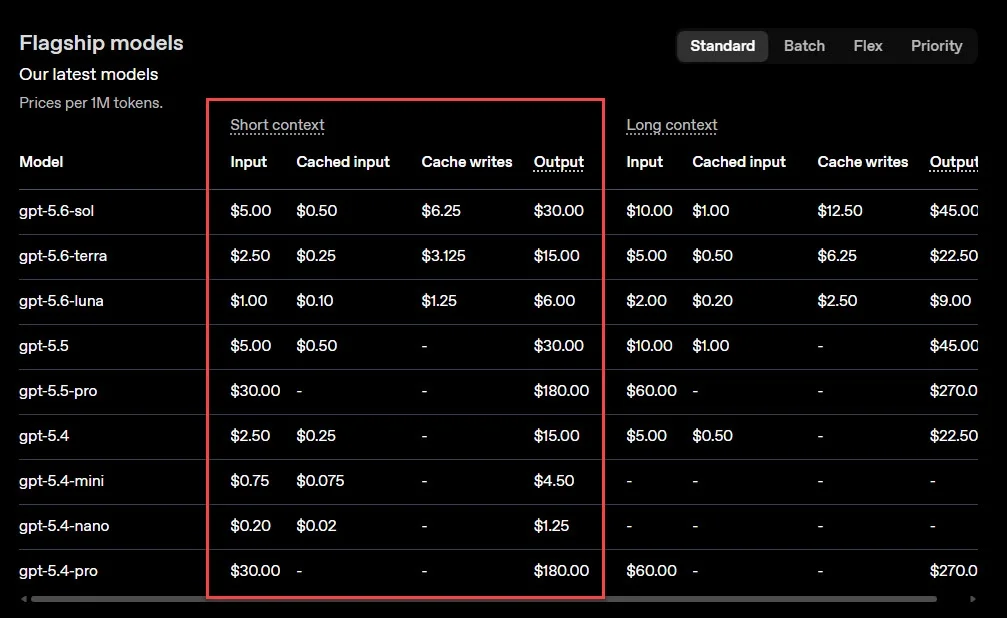
Short Context Pricing
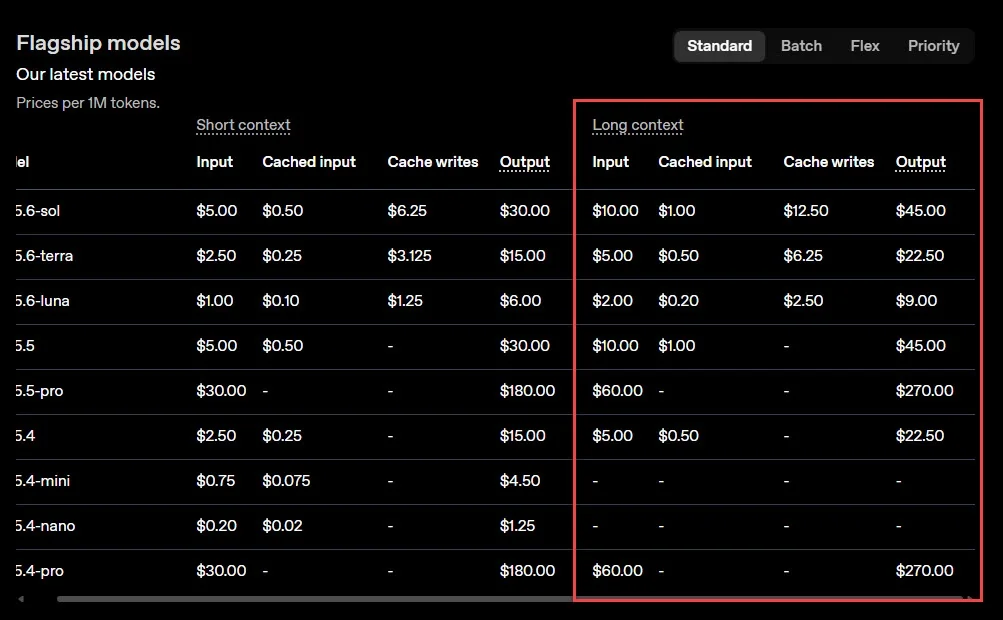
Long Context Pricing
These prices apply to the standard API and continue to use OpenAI’s token-based billing model. GPT-5.6 also introduces an improved prompt caching system, where cached reads are significantly discounted while cache writes are billed at approximately 1.25× the input token price.
How Does GPT-5.6 Compare to GPT-5.5?
One interesting observation is that:
- GPT-5.6 Sol is not cheaper than GPT-5.5.
- Pricing remains largely unchanged.
- The primary improvement comes from higher performance rather than lower cost.
However:
- GPT-5.6 Terra is approximately 50% cheaper than Sol.
- GPT-5.6 Luna is approximately 80% cheaper.
This pricing strategy allows developers to select the most appropriate model instead of relying on a single premium model for every workload.
A New Direction for OpenAI
With GPT-5.6, OpenAI is changing how developers select AI models.
Instead of offering just one premium model, OpenAI now provides three clearly differentiated tiers:
- Sol — Maximum intelligence and reasoning performance.
- Terra — The perfect balance between quality and cost.
- Luna — Optimized for speed, scalability, and affordability.
This approach is similar to offering different performance tiers, making it easier for startups, independent developers, and large enterprises to deploy AI efficiently based on their specific needs.
Conclusion
GPT-5.6 represents more than just another performance upgrade. It also introduces a new product strategy that gives developers greater flexibility when choosing an AI model.
Rather than forcing every application to use the same flagship model, OpenAI now offers three distinct options:
- GPT-5.6 Sol for maximum intelligence, advanced reasoning, software development, and AI agents.
- GPT-5.6 Terra for business applications, automation, content generation, and enterprise assistants.
- GPT-5.6 Luna for high-volume AI services where speed and cost efficiency are the top priorities.
With flexible pricing, improved prompt caching, and multiple performance tiers, GPT-5.6 is expected to become a strong foundation for the next generation of AI-powered applications across startups, enterprises, and independent developers alike.